Staying Ahead of Customer Expectations
skills
Brand Strategy, UX Design
Roles
Director of UX, Creative Director, Brand Strategist
Date
2024

The Business Challenge
The Reformation built its reputation by combining fashion-forward design with a genuine commitment to sustainability. Its blend of contemporary style, limited-edition collections, and environmentally responsible practices made it one of the most influential digitally native fashion brands of its generation.
The business wasn't struggling. It was leading.
The challenge was making sure the customer experience and brand continued to evolve as quickly as customer expectations. In fashion, leadership isn't preserved by standing still. It's preserved by evolving before customers expect you to.
“Our customers love us, we just need to figure out how to keep it that way.”
The Customer Reality
Customers remained deeply loyal to The Reformation. They loved the brand's distinctive aesthetic, commitment to sustainability, and ability to deliver trend-relevant collections without abandoning its environmental values.
But expectations had evolved. Customers increasingly compared every premium retail experience—not just fashion brands. Navigation, product discovery, mobile shopping, merchandising, and checkout all need to feel as refined as the clothing itself.
The products already felt premium. The digital experience needed to communicate the same level of quality.
“I shop a lot online and this experience could be better.”
The Strategic Opportunity
The Reformation already possessed the most difficult asset to earn:
Customer belief.
Its core brand pillars remained highly relevant:
The Cool Girl aesthetic
Sustainable fashion
Radical transparency
Thoughtful product expansion
The opportunity wasn't to redefine the brand. It was to ensure every customer interaction reinforced what customers already admired.
In preparation for its IPO, the company had an opportunity to demonstrate that growth hadn't come at the expense of innovation—and that it continued listening to an increasingly sophisticated customer.





The Transformation
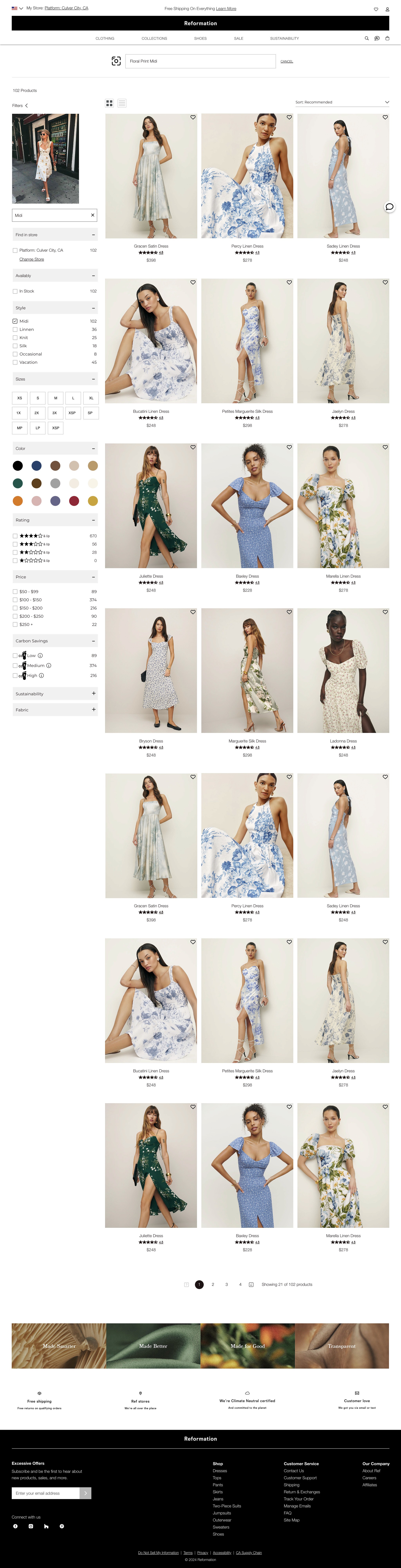
Improving the customer experience required modernizing several foundational aspects of the digital journey, including information architecture, product discovery, merchandising, and purchase flow.
Those improvements were important. But they weren't the real objective.
The greater opportunity was to ensure the digital experience conveyed the same confidence, sophistication, and attention to detail that customers associated with the products themselves. Brand positioning, messaging, navigation, merchandising, and storytelling were approached as one connected system.
Rather than treating UX as a standalone initiative, the redesign reinforced the premium brand promise at every touchpoint. The goal wasn't simply to improve usability. It was to ensure the customer experience evolved at the same pace as the brand's ambition.
Leadership Insight
One of the greatest mistakes successful brands make is believing that leadership can be defended. It can't. It has to be renewed continuously. Organizations often wait until performance declines before evolving. The strongest brands move long before customers begin asking them to.
This project reinforced an important principle: Market leaders don't evolve because they're falling behind. They evolve because staying ahead requires constant reinvention.